
Transcranial magnetic stimulation (TMS) is a non-invasive, evidence-based treatment for depression that works differently from medication, targeting the brain directly using magnetic pulses. For many people, particularly those with treatment-resistant depression, it offers a new pathway forward – with the potential for meaningful improvement and, in some cases, remission.
Transcranial magnetic stimulation (TMS) is a non-invasive treatment that uses magnetic pulses to stimulate areas of the brain involved in mood.
It’s most commonly used for people with depression – particularly when medications or therapy haven’t worked well enough.
Unlike medication, TMS doesn’t involve chemicals entering the body, and you remain awake during treatment.
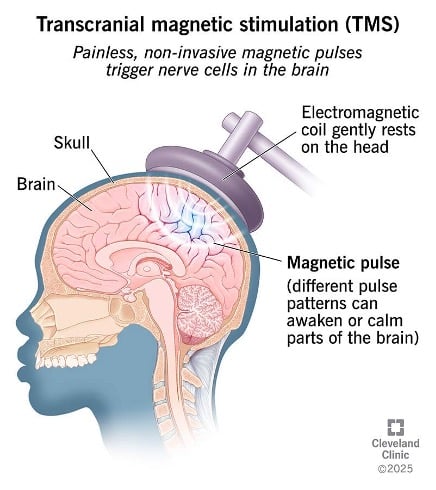
TMS delivers targeted magnetic pulses to specific brain regions linked to mood and emotional regulation.
These pulses help activate underactive brain circuits and rebalance neural activity associated with depression.
Put simply: It’s designed to “re-tune” parts of the brain that aren’t functioning as they should.
TMS is typically considered for people who:
It’s often used in what’s called treatment-resistant depression – when standard treatments haven’t worked sufficiently.
Research shows that:
While results vary, TMS is considered an evidence-based and effective option for depression, particularly when other treatments haven’t worked.
A typical course of TMS:
You can usually return to your normal day immediately after each session.
TMS is generally well tolerated.
Common side effects:
Rare side effects:
Importantly, TMS:
TMS works in a completely different way.
TMS | Antidepressants |
Targets specific brain areas | Affects the whole body |
No daily medication | Daily tablets required |
Minimal systemic side effects | Can include weight gain, fatigue, sexual side effects |
Non-invasive | Chemical-based treatment |
Not always.
TMS may not be suitable if someone has:
A proper assessment with a GP or psychiatrist is always required to determine suitability.
What is TMS in simple terms?
A non-invasive treatment that uses magnetic pulses to stimulate areas of the brain involved in mood.
Does TMS hurt?
Most people feel only mild discomfort or tapping on the scalp.
How long does TMS take to work?
Some people notice changes within a few weeks, but a full course is usually 4–6 weeks.
Is TMS safe?
Yes. It has a strong safety profile, with mostly mild and temporary side effects.
Can TMS cure depression?
It doesn’t work for everyone, but many people experience significant improvement or remission.
If you or someone you care about is living with depression and not getting the results you hoped for from current treatment, there are other options worth exploring.
TMS is one of them – and for some people, it can be a meaningful step forward.
Speak with your GP or psychiatrist, or reach out to our team:
P: 1800 284 830
E: help@avivehealth.com.au
References
Black Dog Institute 2024, Transcranial magnetic stimulation (TMS), Black Dog Institute, viewed 16 April 2026, https://www.blackdoginstitute.org.au/research-centres/neuromodulation-research-centre/transcranial-magnetic-stimulation-tms/.
Cleveland Clinic 2024, Transcranial magnetic stimulation (TMS), Cleveland Clinic, viewed 16 April 2026, https://my.clevelandclinic.org/health/treatments/17827-transcranial-magnetic-stimulation-tms
Mayo Clinic 2023, Transcranial magnetic stimulation, Mayo Clinic, viewed 16 April 2026, https://www.mayoclinic.org/tests-procedures/transcranial-magnetic-stimulation/about/pac-20384625.
RANZCP (Royal Australian and New Zealand College of Psychiatrists) 2018, Repetitive transcranial magnetic stimulation, RANZCP, viewed 16 April 2026, https://www.ranzcp.org/clinical-guidelines-publications/clinical-guidelines-publications-library/repetitive-transcranial-magnetic-stimulation.
Rizvi, SJ, et al. 2019, Use of Transcranial Magnetic Stimulation for Depression, National Center for Biotechnology Information, viewed 16 April 2026, https://pmc.ncbi.nlm.nih.gov/articles/PMC6649915/.
Sax Institute 2018, Transcranial magnetic stimulation for major depression: Evidence check, Sax Institute, viewed 16 April 2026, https://www.saxinstitute.org.au/wp-content/uploads/MoH-TMS-Evidence-Check.pdf.
Please note: TMS is an evidence-based treatment for specific mental health conditions, including treatment-resistant depression. Individual outcomes vary. Treatment suitability is determined following clinical assessment. This information is general in nature and does not replace advice from your health professional.
Join our Avive Health community to get the latest news, straight to your inbox.